Political theorists have spent a lot of ink trying to justify a general duty to obey the law. Other political theorists have shown that these theories are for the most part very good. Furthermore, the first set of theorists then tend to spend a whole lot more ink explaining why this duty to obey the law commonly ceases to apply if you call what you are doing "civil disobedience".
I'm with the philosophical anarchists - there is no general duty to obey the law. The fact that something is a law does not by itself give moral force to the command. That is not to say, however, that we are no obligated to obey many individual laws. In general, however, the laws we must obey are simply that codify either pre-existing rules of basic morality ("Thou shalt not kill") or certain social conventions where such conventions are necessary ("Thou shalt drive on the left", "if thou pollutest, shalt thou pay a fine of £80 for each tonne of CO2 that thou releasest into yon atmosphere.")
This isn't quite a natural law theory - I would argue that there are significant ways in which the moral conventions may vary without losing authority. And yes, some sets of conventions are better than others, but that doesn't mean that people living under inferior conventions can automatically behave as though the preferred conventions were in place.
To the extent that the law as enforced reflects the actual moral law, then, it will be reasonable to expect those who challenge it through civil disobedience to be willing to defend their actions. The moral justifiability of civil disobedience will, pace Raz, depend to a considerable degree upon whether or not the law they challenge is a just one. That said, if someone is wrong but was acting from good intentions, then it may be reasonable to punish them less harshly than if they were simply disregarding the moral law.
A Persian Cafe, Edward Lord Weeks

Friday, 15 April 2016

Monday, 11 April 2016
Tax Avoidance: Government Policy in Action
Since tax avoidance is currently in the news, I'm linking to a couple of interesting articles that I have recently read on this topic. First, Gaps and holes: How the Swiss cheese was made is an account of how the modern system of tax havens developed. The story is basically that during decolonisation, former colonial powers - and especially the UK - were happy to let their former colonies become tax havens because the colonies commonly had no major industries. This didn't impact too much during the formation of welfare states because globalisation hadn't gone all that far, which meant that it was difficult to protect your wealth all that much. As the world shrunk, though, it became vastly easier to earn money in one country but register it elsewhere. Tax avoidance existed prior to globalisation, and was a major source of income for tax havens before globalisation, but it was globalisation which made it the major political issue that it now is.
Second, India's Curry Tax Exclusion Goes Awry is the story of a very fun avoidance scheme in India. The government declared that, in an attempt to lure international food companies to India, all businesses producing curry would face a specially lowered tax rate. Unfortunately, it defined curry not by its function but by its content - with the result that all sorts of companies have been able to access this reduced rate. The extreme end of this is that steel producers have been mixing in peppercorns and declaring the resulting steel to be curry. In a victory for enforcing the law as it is actually written, the courts have upheld this.
The point common to both of these - tax avoidance is not simply something that greedy rich people and corporations do. It is a result, intended or otherwise, of government policy. The fact of tax avoidance is yet another reason why taxes should, above almost all else, be simple.
PS. To be clear, in this piece I am talking entirely about tax avoidance (which is legal) and not about tax evasion (which is illegal). These are related but separate issues and require separate treatment.
Second, India's Curry Tax Exclusion Goes Awry is the story of a very fun avoidance scheme in India. The government declared that, in an attempt to lure international food companies to India, all businesses producing curry would face a specially lowered tax rate. Unfortunately, it defined curry not by its function but by its content - with the result that all sorts of companies have been able to access this reduced rate. The extreme end of this is that steel producers have been mixing in peppercorns and declaring the resulting steel to be curry. In a victory for enforcing the law as it is actually written, the courts have upheld this.
The point common to both of these - tax avoidance is not simply something that greedy rich people and corporations do. It is a result, intended or otherwise, of government policy. The fact of tax avoidance is yet another reason why taxes should, above almost all else, be simple.
PS. To be clear, in this piece I am talking entirely about tax avoidance (which is legal) and not about tax evasion (which is illegal). These are related but separate issues and require separate treatment.
Friday, 8 April 2016
An argument for the subjectivity of reasons
Suppose a man enjoys shooting. In particular, he is into "blind-shooting", in which he shoots in conditions of limited visibility: he sets up a target, along with a mechanism to wave a rattle directly in front of the target, and he aims based upon his judgement of where the sound is coming from.
He is unable to afford an area of private land in which to practice this sport. Instead, he goes out into a public right-of-way area at night to shoot. This is of course a grossly irresponsible sport. We might like to say that, given the risk of hitting someone, there is a strong reason for him not to shoot. Of course, if he could be utterly sure that no-one was in the vicinity, then this reason would go away.
It is simply false to say that if there is a person who could be hit, he has a reason, and if there is not, then he lacks a reason. The reason for not shooting comes from his personal, subjective inability to confirm that no-one is in any danger of being shot.
He is unable to afford an area of private land in which to practice this sport. Instead, he goes out into a public right-of-way area at night to shoot. This is of course a grossly irresponsible sport. We might like to say that, given the risk of hitting someone, there is a strong reason for him not to shoot. Of course, if he could be utterly sure that no-one was in the vicinity, then this reason would go away.
It is simply false to say that if there is a person who could be hit, he has a reason, and if there is not, then he lacks a reason. The reason for not shooting comes from his personal, subjective inability to confirm that no-one is in any danger of being shot.
Thursday, 7 April 2016
A Bold Thesis
Informal logic is stuck in a quagmire, and has been since
Aristotle. It relies upon an aspiration to certainty, but this is unrealistic
and is in fact harmful for the way we think about logic. We reject as
“fallacies” various argumentative forms merely because they fail to guarantee
the truth of their conclusions, even though from a Bayesian perspective they
provide evidence for these conclusions. Consequently, many of these are
perfectly valid argumentative forms and in some cases are unavoidable. Examples
include affirming the consequent, the appeal to authority (to which ad hominem may be a perfectly good
response), slippery slopes, etc. It is simply false to say that use of a fallacy will undermine the logic of one’s argument.
Study Design Bleg
I'm interested in the question of whether there are appreciable differences in the quality of parenting received by adopted children and children raised by their biological parents. Obviously this is an empirical question, so before I commit to any empirical investigation I want to be as confident as possible that a potential investigation would really be measuring what I hope to measure.
The standard way to answer questions about the effects of parenting and genes is through twin studies, which compare the achievement and variance thereof between identical twins raised by different families. It's not hard to think of set-ups of such studies which would allow us to test the hypothesis that there are indeed differences in the quality of parenting given to biological and adopted children; however, I'm struggling to think of set-ups that are actually likely to exist in sizeable numbers. Are there really likely to be many cases, for example, of pairs of identical twins where each set of parents raised one member of each set of twins?
The best design that I've so far been able to come up with and subsequently remember long enough to write down is to compare the achievement of children adopted by extended family with that of children adopted by non-relatives. If there is a biological dimension to whatever causes good parenting, we should expect it to be at least somewhat present when raising nephews, nieces, and grandchildren. Unfortunately there's a confound, in that having extended family who are willing and able to adopt your children is itself a fairly good indicator, so we may end up measuring things other than parenting quality.
Any ideas on other study designs or for improvements?
The standard way to answer questions about the effects of parenting and genes is through twin studies, which compare the achievement and variance thereof between identical twins raised by different families. It's not hard to think of set-ups of such studies which would allow us to test the hypothesis that there are indeed differences in the quality of parenting given to biological and adopted children; however, I'm struggling to think of set-ups that are actually likely to exist in sizeable numbers. Are there really likely to be many cases, for example, of pairs of identical twins where each set of parents raised one member of each set of twins?
The best design that I've so far been able to come up with and subsequently remember long enough to write down is to compare the achievement of children adopted by extended family with that of children adopted by non-relatives. If there is a biological dimension to whatever causes good parenting, we should expect it to be at least somewhat present when raising nephews, nieces, and grandchildren. Unfortunately there's a confound, in that having extended family who are willing and able to adopt your children is itself a fairly good indicator, so we may end up measuring things other than parenting quality.
Any ideas on other study designs or for improvements?
Wednesday, 6 April 2016
Notes on Prague and ESFLC 2016
Last month the 2016 European Students for Liberty Conference (ESFLC) was held in Prague. The weekend of the conference happened to be followed by two Hungarian national holidays, so it seemed an entirely natural time to pay a visit to the city.
I caught the overnight train from Keleti Station in Budapest, arriving in Prague at 6:30am on the Saturday. As the train sidled towards Prague station I had a dramatic view of the city, which was something like this (I was too slow to get a picture myself):

The other thing is that not everything is as elegant as these highlights. The Vltava - at least as it appeared that morning - was a dull river bounded by sheer concrete. One could hardly imagine travelling down it for leisure.
It should be noted that it was overcast, weather which does not portray the city ideally. Furthermore, I was short on sleep from having struggled to grab even twenty winks on the train as it stopped and started its way through Slovakia and the Czech Republic. So perhaps this was something of an unfair judgement.
I spent a fair while at the conference waiting for it to begin. Eventually there was a breakfast, and then I went to a session on Freedom in Education. The biggest problem with this session - aside from the seats, which were spring loaded and would snap back upwards with a crash to deafen the whole room - was that all of the speakers seemed to have different ideas of what was meant by "freedom in education". One speaker was a French academic who was frustrated with the way that the left dominates the academy, and so viewed this as being about changing the curriculum to include more of the ideas of freedom. Another was concerned with trying to achieve a free market in education, to wrest control of schools from the government. Yet another was promoting the idea that schools should allow greater freedom to their pupils in terms of what they do in school. None of these are misinterpretations of the phrase "freedom in education", but the diversity of interests meant that they had very little to say to each other and the session was little more than a group of people each putting forward an viewpoint that they happened to hold.
The next talk I went to was much more interesting: a defence of Marx. To be clear, this was an ex-Marxist who was playing devil's advocate, and it focused only upon Marx's theory of historical progression. That said, it was a useful session which filled in a couple of the gaps that existed in my understanding of Marxist theory.
After this, there was lunch. All meals at the conference were provided, with the cost being included in the ticket price. Unsurprisingly there were long queues waiting to be served food, and the vegetarian food ran out quickly. You'd have thought that of all people, libertarians would realise that central provision of food at below-market price inevitably leads to queues and starvation.
Immediately following lunch there was a keynote speech on the subject of noticing and responding to surveillance. I arrived a bit late, got a bad seat, and couldn't really hear it. In the mid-afternoon there were a range of activities. Ever the political philosophy nerd, I went to a discussion of the link between religion and politics. I can't say it was very high quality; that said, it was probably no worse than the average undergraduate seminar. Other events included a gun-shooting session, because this was a libertarian conference and if there's one thing we like more than freedom, it's making use of that freedom in ways that annoy people.
I have no idea what I did following this. In any case, for the final session of the day I went to a talk given by Edward Stringham presenting some of the stuff from his book on how markets can exist even in the absence of government courts and regulation. It was much more strident than his appearance on EconTalk.
At this point there were a couple of hours going spare, so I went to the Easter Market in the Old Town Square. There was some traditional music and dance being performed, which made me nostalgic for the weekends I used to spend at IVFDF.

In the evening there was a thing going on at a club which had the enviable location of being in the middle of the Vltava. There was a good band playing live, we each got a free drink, and I had a couple of interesting conversations - one with a couple of guys from the other end of the Czech Republic, and one with Edward Stringham and with a girl from the Faroe Islands.
On Sunday morning, there was once again breakfast and I was able to have a conversation (along with three or four other students) with Bob Murphy. I can confirm that his unhealthy obsession with Paul Krugman is as present in real life as it is on the internet.
The first session I went to was one on the ancient Brehon law of Ireland, back in the days before England imposed a state on them. The talk was given by one Kevin Flanagan Coombes, whom you may guess from the name was himself Irish. Indeed half the talk seemed to be talking about how much the Irish were known for their love of justice. That said, there were some fascinating claims that I'd love to see made in a medium that people are more inclined to trust. These ranged from facts about the law (e.g. if a stranger arrived in an area, you were legally required to provide hospitality. This facilitated trade, and explains why the Irish are so friendly: because they would have been punished if they weren't) to its applications (e.g. apparently many tribes across the world who lack a written record of their laws have essentially adopted Brehon law, as they have judged it to be sufficiently similar to their own law to be indistinguishable). If half of these are true, it would greatly affect the way we think about law. Unfortunately, based upon some of his rather murky exegesis of the philosophy of law, I am not convinced that Mr. Flanagan Coombes is the best person to draw out these implications.
I didn't go to a second session, since none of them looked interesting. Instead I got my Kindle and read for a bit. Finally, the conference was closed by a talk given by Tom Palmer on students who had achieved great things for liberty. I didn't really real comfortable in the talk, it seemed very self-congratulatory to listen to a man talk about how we were all awesome and could change the world.
After scrounging as much as I could from what was left over from breakfast, I set out to make the most of the portion of the day which was left. Having not especially enjoyed the first day-and-a-half of my stay, I was determined not to waste the remaining two days.

There wasn't really time to go very far, so I had a look around the Jewish museum. The main museum wasn't very big, and the most interesting exhibit was a touchscreen which told the history of Jews in various places across Bohemia. The numbers of Jewish families seemed to be very variable, presumably due to the perpetual threat of Pogroms.

The museum closed before I had a chance to visit any of the synagogues, although fortunately the ticket was good for several days. Instead I went to have a look at the Powder Tower.

The next day I woke up bright and early in order to see Prague Castle. The weather had picked up very pleasantly, and on my way past the Astronomical Clock (I was staying at a hostel perhaps 100m away from it - the Prague Square Hostel, highly recommended) I was able to get this snap:

I took more photos on the way. This one should both show the grandeur of the castle, and the grimness of the river:

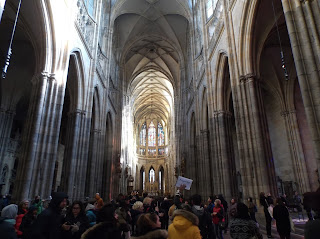
I spent the morning going round the castle. I don't have many photos due to the camera policies in there, but most of it wasn't especially visually interesting. There were some interesting stories - a defenestrated minister here, an enterprising artillery company there - but the bits I remember most strongly are the basilica and the Golden Lane.



I was also intrigued by the legend of Dalibor, a knight who was imprisoned, tortured and executed for treason. He confessed to this treason on the rack, from which sprang the saying that "In prison, out of necessity Dalibor began to fiddle." Some centuries this was taken literally and a legend appeared that, with nothing better to do, he had learned to play the violin - and had played it so beautifully that people came from miles around to hear him. I doubt anyone above the age of twelve ever believed this latter story, but it's still a nice legend (if you ignore the whole being-hung-drawn-and-quartered thing).

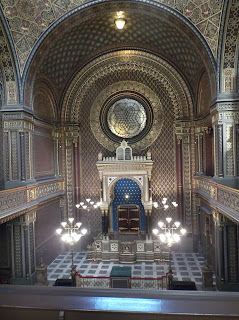
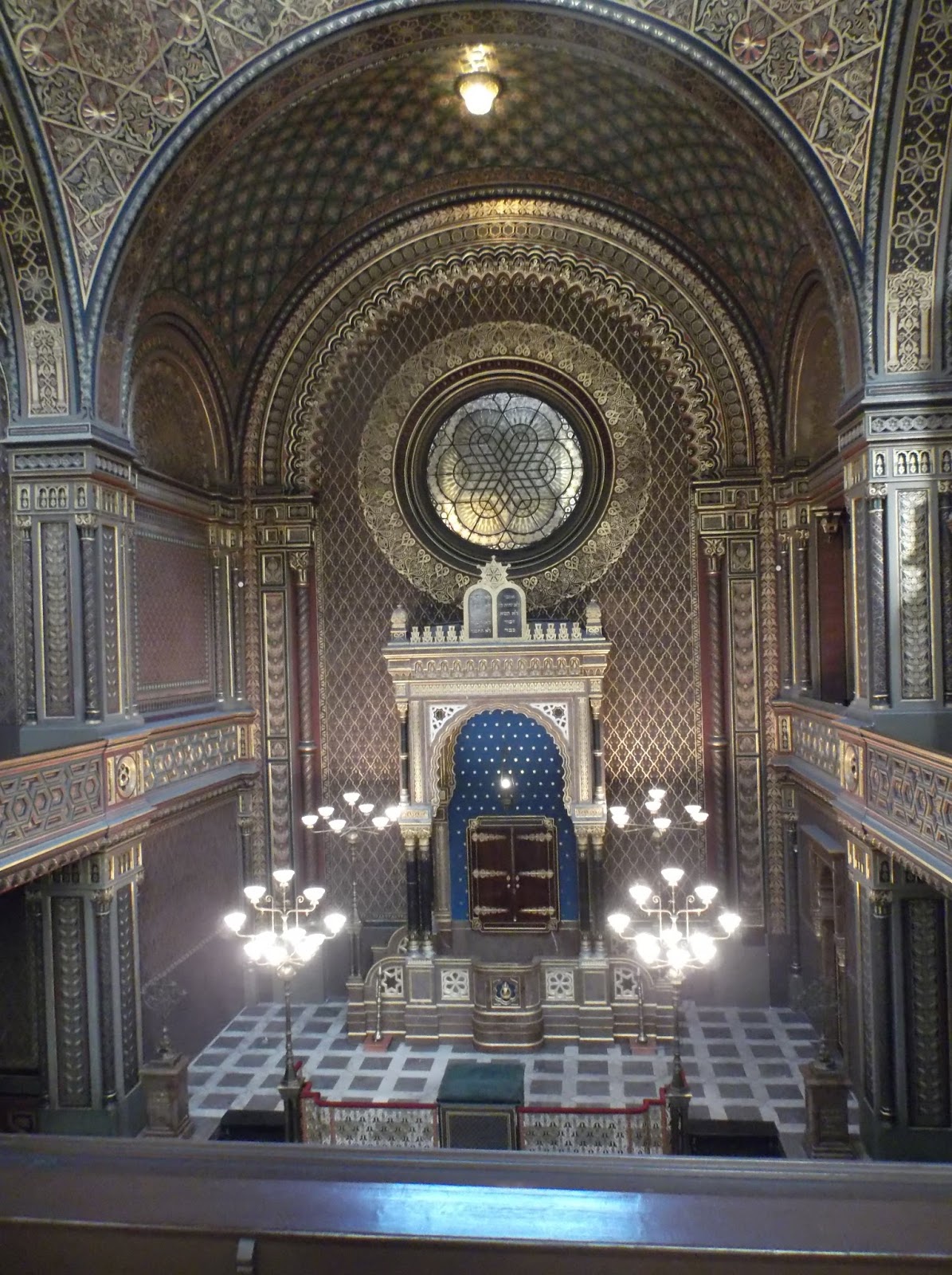
In the afternoon I wasted a lot of time trying to visit an exhibition of the national gallery, forgetting that it was closed. With the second half of the afternoon I went around the Spanish Synagogue, a joyous explosion of colour that, had my 23andme results arrived sooner, would have made me proud of my (miniscule) Jewish ancestry.



I caught the overnight train from Keleti Station in Budapest, arriving in Prague at 6:30am on the Saturday. As the train sidled towards Prague station I had a dramatic view of the city, which was something like this (I was too slow to get a picture myself):

My first thought was, "Wow, this is really beautiful." My second was, "Wow, it's dirty." Making my way to the conference via the scenic route, I saw a fair bit to confirm my initial impression. There are beautifully painted buildings of the sort that you simply do not see in Budapest - but there seems to be far less pride taken in it. The shops on the ground floors of grand facades make no attempt to blend in, and there's graffiti everywhere (including on the Czech parliament building!).
The other thing is that not everything is as elegant as these highlights. The Vltava - at least as it appeared that morning - was a dull river bounded by sheer concrete. One could hardly imagine travelling down it for leisure.
It should be noted that it was overcast, weather which does not portray the city ideally. Furthermore, I was short on sleep from having struggled to grab even twenty winks on the train as it stopped and started its way through Slovakia and the Czech Republic. So perhaps this was something of an unfair judgement.
 |
| A typically well-decorated building, ruined by the shops on the ground floor. |
The next talk I went to was much more interesting: a defence of Marx. To be clear, this was an ex-Marxist who was playing devil's advocate, and it focused only upon Marx's theory of historical progression. That said, it was a useful session which filled in a couple of the gaps that existed in my understanding of Marxist theory.
After this, there was lunch. All meals at the conference were provided, with the cost being included in the ticket price. Unsurprisingly there were long queues waiting to be served food, and the vegetarian food ran out quickly. You'd have thought that of all people, libertarians would realise that central provision of food at below-market price inevitably leads to queues and starvation.
Immediately following lunch there was a keynote speech on the subject of noticing and responding to surveillance. I arrived a bit late, got a bad seat, and couldn't really hear it. In the mid-afternoon there were a range of activities. Ever the political philosophy nerd, I went to a discussion of the link between religion and politics. I can't say it was very high quality; that said, it was probably no worse than the average undergraduate seminar. Other events included a gun-shooting session, because this was a libertarian conference and if there's one thing we like more than freedom, it's making use of that freedom in ways that annoy people.
I have no idea what I did following this. In any case, for the final session of the day I went to a talk given by Edward Stringham presenting some of the stuff from his book on how markets can exist even in the absence of government courts and regulation. It was much more strident than his appearance on EconTalk.
At this point there were a couple of hours going spare, so I went to the Easter Market in the Old Town Square. There was some traditional music and dance being performed, which made me nostalgic for the weekends I used to spend at IVFDF.

In the evening there was a thing going on at a club which had the enviable location of being in the middle of the Vltava. There was a good band playing live, we each got a free drink, and I had a couple of interesting conversations - one with a couple of guys from the other end of the Czech Republic, and one with Edward Stringham and with a girl from the Faroe Islands.
On Sunday morning, there was once again breakfast and I was able to have a conversation (along with three or four other students) with Bob Murphy. I can confirm that his unhealthy obsession with Paul Krugman is as present in real life as it is on the internet.
The first session I went to was one on the ancient Brehon law of Ireland, back in the days before England imposed a state on them. The talk was given by one Kevin Flanagan Coombes, whom you may guess from the name was himself Irish. Indeed half the talk seemed to be talking about how much the Irish were known for their love of justice. That said, there were some fascinating claims that I'd love to see made in a medium that people are more inclined to trust. These ranged from facts about the law (e.g. if a stranger arrived in an area, you were legally required to provide hospitality. This facilitated trade, and explains why the Irish are so friendly: because they would have been punished if they weren't) to its applications (e.g. apparently many tribes across the world who lack a written record of their laws have essentially adopted Brehon law, as they have judged it to be sufficiently similar to their own law to be indistinguishable). If half of these are true, it would greatly affect the way we think about law. Unfortunately, based upon some of his rather murky exegesis of the philosophy of law, I am not convinced that Mr. Flanagan Coombes is the best person to draw out these implications.
I didn't go to a second session, since none of them looked interesting. Instead I got my Kindle and read for a bit. Finally, the conference was closed by a talk given by Tom Palmer on students who had achieved great things for liberty. I didn't really real comfortable in the talk, it seemed very self-congratulatory to listen to a man talk about how we were all awesome and could change the world.
After scrounging as much as I could from what was left over from breakfast, I set out to make the most of the portion of the day which was left. Having not especially enjoyed the first day-and-a-half of my stay, I was determined not to waste the remaining two days.

There wasn't really time to go very far, so I had a look around the Jewish museum. The main museum wasn't very big, and the most interesting exhibit was a touchscreen which told the history of Jews in various places across Bohemia. The numbers of Jewish families seemed to be very variable, presumably due to the perpetual threat of Pogroms.

The museum closed before I had a chance to visit any of the synagogues, although fortunately the ticket was good for several days. Instead I went to have a look at the Powder Tower.

The next day I woke up bright and early in order to see Prague Castle. The weather had picked up very pleasantly, and on my way past the Astronomical Clock (I was staying at a hostel perhaps 100m away from it - the Prague Square Hostel, highly recommended) I was able to get this snap:

I took more photos on the way. This one should both show the grandeur of the castle, and the grimness of the river:

I spent the morning going round the castle. I don't have many photos due to the camera policies in there, but most of it wasn't especially visually interesting. There were some interesting stories - a defenestrated minister here, an enterprising artillery company there - but the bits I remember most strongly are the basilica and the Golden Lane.


 |
| Pictures of the basilica. |


 |
| Some breathtakingly stupid weapons. Enjoy trying to swing a pistol, especially since you've taken the handle and axehead out of ideal alignment. And what is with that mechanical crossguard on the sword? |

 |
| Pictures of Prague from the castle. |

In the evening I went to a concert given in one of the churches by an organist and a small string orchestra. Hearing Bach on a proper organ is always a delight, and it was almost enough to let me forget how overpriced it was (at least compared to what I'm used to). Indeed, Prague in general is ridiculously expensive - more pricey than Manchester, more than twice as expensive as Budapest.
This was my final evening in Prague, which meant that it was a good time to visit the Prague Beer Museum. It's called a museum but it's really a pub with an unusually wide range of beers. Nevertheless, I was able to get a set of five contrasting beers, in small glasses of 150ml each.
 |
| #SquadGoals |
To be honest I wasn't massively keen on most of them. A couple were somewhat experimental beers that didn't quite work out, but that's fine. Another was a bitter that, given a few years, I am sure I will mature into. The one I did enjoy was the one at the end, which was very light and a welcome relief from the previous beers, which had got steadily heavier.
After another good night's sleep, I made my way to the Kafka Museum. On the way I walked across the Charles Bridge, which remains a highlight of the journey. That's one thing which Budapest simply has no equivalent to. I have photos, but because I forgot my camera and instead used my phone they're potato quality:

Outside the museum was a somewhat obscene statue of two men urinating into the Czech Republic. Perhaps it was artistic; it was definitely crude. Their waists were moving from side to side, so that the streams of water were constantly moving.

Photos were prohibited within the actual museum. All I can say is that it gave a very good impression of the twisted, dystopian aesthetic of which Kafka was perhaps the greatest promulgator, and that I cam away knowing rather more of Kafka than I did when I went in.
After picking up my bags from the hostel, I went to the Antonin Dvorak museum. This is a modest museum, set in a single small building not far from the train station. It was by far the best value thing I did while there, at 30Kr (about £1) for entry.


After this I made my way to the train station and caught a train back to Budapest. Overall I'm happy to have gone to Prague, but will be quite happy if I never go again. If you want to experience the Central European aesthetic then there are far cheaper places to do so; Prague is arguably most exquisite than Budapest, though, and is undoubtedly far more walkable.
If you want to go to a Central European city for a stag weekend, please go to Prague and not Budapest. (a) It has better nightlife, and (b) you've already ruined bits of Prague. Please don't bring Budapest down to that level of tackiness.
If you want to go to a Central European city for a stag weekend, please go to Prague and not Budapest. (a) It has better nightlife, and (b) you've already ruined bits of Prague. Please don't bring Budapest down to that level of tackiness.
Monday, 4 April 2016
Your Argument is Bad (and Dangerous) and You Should Feel Bad
The CEU Philosophy department recently held a conference for graduate students. That is, most of the talks were by graduate students from across Europe, there were responses given by CEU students, and the keynote speeches were given by the professors involved in organising it. I wasn't at much of the conference, but one talk I heard was so appalling that I feel the need to make a public record of this.
To be clear, this was not a talk by a graduate student. This was by a professor from elsewhere who came here in order to help run the conference. The reason for my strenuous objection is not that it is merely wrong (lots of philosophical ideas and arguments are wrong) or even that it was a bad argument (although even by the low standards of academic philosophy it was). This argument is dangerous.
The conclusion of the argument is that "holding different values from a person constitutes an epistemically sound reason to regard them as unreliable in fields in which they are expert". That is to say, if you disagree with them about politics then you are justified in ignoring whatever they have to say - even in fields you know very little about.
How does one justify such a remarkable position? We begin with the question of how far one ought to defer to experts. Clearly experts are not always reliable, but we would like to be able to assess whether or not to believe them without going through the long and difficult process of gaining all the same knowledge that they have. The speaker therefore distinguished the cases where there is general agreement and where there is widespread disagreement between experts. In cases where there is general agreement, we should go with expert consensus. In cases where there is disagreement, we need some way of establishing which to trust.
This is about as far as I am willing to agree with the speaker. There is as yet no draft of the paper - this was, the speaker remarked, the first time she had discussed these thoughts publicly - so you will have to trust from this point onwards that I am presenting her views faithfully and accurately.
Before moving on, I think she might have benefited from drawing a distinction between consensus of experts and consensus of papers. If all the experts in a field conclude that X, then I'm going to be strongly inclined to believe X. If all the papers on the subject conclude that X, then while I will probably still accept X I'm going to also be heavily suspicious that there is some bias in the publication procedure. The speaker's example of consensus was global warming, and she quoted some meta-analysis which looked at more than 900 papers and found that they all pointed towards the existence of AGW. Sure, AGW is definitely a thing, but is it really plausible than in 900 studies, none of them would by chance fail to detect it? There's something fishy going on either with that meta-analysis or with the way the speaker reported it.
That said, how did the argument continue? The speaker claimed that deciding when a risk is worth taking will require a kind of judgement. Her example involved some ecological risk relating to bees. Suppose the downside of this risk has a 5% chance of occurring. Is that a big enough risk that we ought to consider action?
Ultimately, she claimed, this is a value judgement. So if one ecologist tells us we should beware of this risk and another says we don't need to, in order to decide which one to trust we need to know which shares our values where risk-taking is concerned. So if an expert has significantly different values from you, this constitutes a reason to give less weight to their testimony relative to those experts with whom you have shared values.
There are, so far as I can see, four gaping holes in her argument. The first is a simple failure to apply Bayesian epistemology. When we say "there is a 5% chance that a large comet will strike earth in the next 10,000 years", this does not mean that the universe is indeterminate and has a 5% chance of resolving into a situation where a large comet strikes the earth: rather, we mean that we lack the information necessary to establish definitively whether or not earth will be hit by a comet, but based on the information which is available we attribute a 5% probability to it happening in the next 10,000 years. Furthermore, it is fine to act based upon this kind of partial information. Indeed, it is all that we can do.
So there is no need for some "critical point" at which a risk becomes worth considering. We can simply do a standard cost-benefit analysis in which the ethical weights given to events are multiplied by our best guesses at the probability of those events.
The second is that even if there were some "critical point" of this sort, or even a Sorites-paradox-type thing where really tiny risks should be ignored and we're never quite certain when they become important to think about, and it were subjectively determined in the way our speaker took it to be - this would be a far cry from what we ordinarily refer to as "values". It would be something much more contained and precise - call it "risk tolerance". I'm sure the speaker would recognise this if pointed to it - but the fact remains that she chose to use the word "values" in a very loose and careless way.
Third, we already have an approximation of this "critical point". It's called statistical significance.
Finally, she leaves aside the extent to which our values are determined by other things, which may be the very things whose truth we aim to question. There are experts on the philosophy of religion who believe in God, and there are those who do not. If we privilege the testimony of those with whom we share values, then when considering the existence of deities Christians will have a good reason to privilege the testimony of fellow Christians, Hindus to privilege the testimony of fellow Hindus, and atheists to privilege the testimony of fellow neckbeards. But this is blatantly bad epistemic practice!
The thesis of this talk, if accepted by mainstream society, would destroy the ability to have sensible political and scientific discourse. Being dangerous does not automatically that philosophy is bad or wrong - if democracy is the only way to avoid either feudal warlords or tyrannical dictators then Jason Brennan's work is dangerous, but that doesn't mean his work is low quality. But when you are pushing a potentially dangerous thesis, you have not only prudential reasons but also a moral requirement to make the best argument you can. This speaker flagrantly failed to do so.
To be clear, this was not a talk by a graduate student. This was by a professor from elsewhere who came here in order to help run the conference. The reason for my strenuous objection is not that it is merely wrong (lots of philosophical ideas and arguments are wrong) or even that it was a bad argument (although even by the low standards of academic philosophy it was). This argument is dangerous.
The conclusion of the argument is that "holding different values from a person constitutes an epistemically sound reason to regard them as unreliable in fields in which they are expert". That is to say, if you disagree with them about politics then you are justified in ignoring whatever they have to say - even in fields you know very little about.
How does one justify such a remarkable position? We begin with the question of how far one ought to defer to experts. Clearly experts are not always reliable, but we would like to be able to assess whether or not to believe them without going through the long and difficult process of gaining all the same knowledge that they have. The speaker therefore distinguished the cases where there is general agreement and where there is widespread disagreement between experts. In cases where there is general agreement, we should go with expert consensus. In cases where there is disagreement, we need some way of establishing which to trust.
This is about as far as I am willing to agree with the speaker. There is as yet no draft of the paper - this was, the speaker remarked, the first time she had discussed these thoughts publicly - so you will have to trust from this point onwards that I am presenting her views faithfully and accurately.
Before moving on, I think she might have benefited from drawing a distinction between consensus of experts and consensus of papers. If all the experts in a field conclude that X, then I'm going to be strongly inclined to believe X. If all the papers on the subject conclude that X, then while I will probably still accept X I'm going to also be heavily suspicious that there is some bias in the publication procedure. The speaker's example of consensus was global warming, and she quoted some meta-analysis which looked at more than 900 papers and found that they all pointed towards the existence of AGW. Sure, AGW is definitely a thing, but is it really plausible than in 900 studies, none of them would by chance fail to detect it? There's something fishy going on either with that meta-analysis or with the way the speaker reported it.
That said, how did the argument continue? The speaker claimed that deciding when a risk is worth taking will require a kind of judgement. Her example involved some ecological risk relating to bees. Suppose the downside of this risk has a 5% chance of occurring. Is that a big enough risk that we ought to consider action?
Ultimately, she claimed, this is a value judgement. So if one ecologist tells us we should beware of this risk and another says we don't need to, in order to decide which one to trust we need to know which shares our values where risk-taking is concerned. So if an expert has significantly different values from you, this constitutes a reason to give less weight to their testimony relative to those experts with whom you have shared values.
There are, so far as I can see, four gaping holes in her argument. The first is a simple failure to apply Bayesian epistemology. When we say "there is a 5% chance that a large comet will strike earth in the next 10,000 years", this does not mean that the universe is indeterminate and has a 5% chance of resolving into a situation where a large comet strikes the earth: rather, we mean that we lack the information necessary to establish definitively whether or not earth will be hit by a comet, but based on the information which is available we attribute a 5% probability to it happening in the next 10,000 years. Furthermore, it is fine to act based upon this kind of partial information. Indeed, it is all that we can do.
So there is no need for some "critical point" at which a risk becomes worth considering. We can simply do a standard cost-benefit analysis in which the ethical weights given to events are multiplied by our best guesses at the probability of those events.
The second is that even if there were some "critical point" of this sort, or even a Sorites-paradox-type thing where really tiny risks should be ignored and we're never quite certain when they become important to think about, and it were subjectively determined in the way our speaker took it to be - this would be a far cry from what we ordinarily refer to as "values". It would be something much more contained and precise - call it "risk tolerance". I'm sure the speaker would recognise this if pointed to it - but the fact remains that she chose to use the word "values" in a very loose and careless way.
Third, we already have an approximation of this "critical point". It's called statistical significance.
Finally, she leaves aside the extent to which our values are determined by other things, which may be the very things whose truth we aim to question. There are experts on the philosophy of religion who believe in God, and there are those who do not. If we privilege the testimony of those with whom we share values, then when considering the existence of deities Christians will have a good reason to privilege the testimony of fellow Christians, Hindus to privilege the testimony of fellow Hindus, and atheists to privilege the testimony of fellow neckbeards. But this is blatantly bad epistemic practice!
The thesis of this talk, if accepted by mainstream society, would destroy the ability to have sensible political and scientific discourse. Being dangerous does not automatically that philosophy is bad or wrong - if democracy is the only way to avoid either feudal warlords or tyrannical dictators then Jason Brennan's work is dangerous, but that doesn't mean his work is low quality. But when you are pushing a potentially dangerous thesis, you have not only prudential reasons but also a moral requirement to make the best argument you can. This speaker flagrantly failed to do so.
Subscribe to:
Comments (Atom)