Earlier this week, I was studying Saul Kripke's Identity and Necessity, in which he sets out an argument as to precisely which relations of identity are metaphysically necessary. Briefly, he divides all names and descriptions into "rigid" and "non-rigid" designators: rigid designators, such as proper names and technical terms such as 'heat' refer to the same thing across different possible worlds; non-rigid designators, on the other hand, refer to different things across different possible worlds. (This is not to be confused with different worlds using different words to refer to the same thing - in Kripke's system, "Andrew" refers to me even in worlds where I am known as "Christopher" or "Timothy" or even "Jessica").
According to Kripke, any identity statement in which both objects are referred to by rigid designators is necessarily either true or false. So "Andrew is the son of Tim" is necessarily true for all worlds where I exist, and "Andrew is the brother of Chris" is necessarily true for all worlds where both my brother and I exist; however, "Tim is the editor of Overdrive" and "Andrew was the Chess captain 2010-12 at Camp Hill Boys" are merely contingently true - that is to say, there are possible worlds where they are not true.
As it happens, I do not agree with Kripke's view of personal identity - he relies on the assumption that there is something which is irreducibly "me", whereas I would tend towards viewing objects merely as the sum of their properties. However, suppose he is correct regarding identity of real-life people. Does this still hold for fictional characters?
One old trope of fanfiction is to change who one or more parents of a character is. This is mainly done for shipping purposes - for example, making Harry Potter the son of Snape in order to ship Snape/Lily, or removing the sibling relationship between Elsa and Anna so that "it isn't incest". Except that, under Kripke's theory of identity, it is incest and there's nothing you can do about it without making them two fundamentally different characters.
Under my preferred theory of identity, this is not the case since the characters in a fanfic cease to be the same characters as those of the original as soon as even the slightest difference appears between them. I'm still a bit concerned as to precisely why one would want to ship Elsanna, but I can sort-of allow that "it isn't incest". (Even if it was, that would be far from the worst relationship going on in fanfiction - that 'honour', within the bounds of what I've encountered, would be Harry/Fem!Harry fics...)
A Persian Cafe, Edward Lord Weeks

Friday, 28 March 2014

Thursday, 20 March 2014
Selfies
Currently there's a trend going around Facebook for girls posting selfies without make-up. There are more than enough photos of me on Facebook, but for the record here is a photo, taken just now, of me without any make-up on.

For contrast, here is a picture of me with make-up, taken at my flatmate's birthday party a few weeks ago.

Sunday, 16 March 2014
IVFDF 2014 Recap, part 2
Following on from here:
The first dance I headed to on Saturday afternnon was a Contra dance, with music by Vertical Expression. Unfortunately I didn't make any notes, but from what I can remember two weeks on it the music was fine and the calling was by Rhodri Davies, who is the best dance caller I have yet to encounter.


I wanted to do a range of different dances, so at about 10:15 I headed across to McEwan Hall for a Scottish country dance with music by the Ian MacPhail Band. The description of the dance in the event program notes that earlier in the day there were workshops on Scottish country dance at which people could "try the footwork and become experts in some of this evenings dances!" It also notes that this is merely optional and is not in any way necessary, but perhaps this is not entirely truthful: it involved the most mentally taxing dancing I've ever done. It was still enjoyable, but I felt rather a lemon trying to get right all the approaches and turns and reels and repeatedly failing. McEwan Hall was an incredible location, though. Obviously I don't have any of my own pictures, my camera having gone by this point, but the one below is from the internet; imagine it without any of the chairs and steps in the middle.

After this, I headed back to the sports hall in order to plan Sunday and to sleep. The first workshop I went to on Sunday morning was the annual "Dances with a Difference" session, which was great fun. The most memorable dance was one in which the eight dancers of a set pretended to be a helicopter, although the one which most impressed me with its design was a long-wave sets dance with many turns and do-si-dos, each leading immaculately into the next. The venue was another good one, the debating hall at Teviot House - very elegant and neatly furnished. I had fun trying to imagine Adam Smith and David Hume on the stage.
Following on from this, I went to a session entitled "Songs of Scotland" taken by a young guy from the university. It was a good session, although at first the singing was weakened by the lack of handouts of the words for some songs. This was one of the songs we sang, though as you would expect it was considerably less polished. The session is also notable for having produced the only photo of the weekend in which I can find myself (centre-right, just to the right of the guy on the chair):


The first dance I headed to on Saturday afternnon was a Contra dance, with music by Vertical Expression. Unfortunately I didn't make any notes, but from what I can remember two weeks on it the music was fine and the calling was by Rhodri Davies, who is the best dance caller I have yet to encounter.
Pictures of the Contra Dancing, taken by Arctica Lsdnwikwnef (many thanks!)
I wanted to do a range of different dances, so at about 10:15 I headed across to McEwan Hall for a Scottish country dance with music by the Ian MacPhail Band. The description of the dance in the event program notes that earlier in the day there were workshops on Scottish country dance at which people could "try the footwork and become experts in some of this evenings dances!" It also notes that this is merely optional and is not in any way necessary, but perhaps this is not entirely truthful: it involved the most mentally taxing dancing I've ever done. It was still enjoyable, but I felt rather a lemon trying to get right all the approaches and turns and reels and repeatedly failing. McEwan Hall was an incredible location, though. Obviously I don't have any of my own pictures, my camera having gone by this point, but the one below is from the internet; imagine it without any of the chairs and steps in the middle.

After this, I headed back to the sports hall in order to plan Sunday and to sleep. The first workshop I went to on Sunday morning was the annual "Dances with a Difference" session, which was great fun. The most memorable dance was one in which the eight dancers of a set pretended to be a helicopter, although the one which most impressed me with its design was a long-wave sets dance with many turns and do-si-dos, each leading immaculately into the next. The venue was another good one, the debating hall at Teviot House - very elegant and neatly furnished. I had fun trying to imagine Adam Smith and David Hume on the stage.
Following on from this, I went to a session entitled "Songs of Scotland" taken by a young guy from the university. It was a good session, although at first the singing was weakened by the lack of handouts of the words for some songs. This was one of the songs we sang, though as you would expect it was considerably less polished. The session is also notable for having produced the only photo of the weekend in which I can find myself (centre-right, just to the right of the guy on the chair):
Again, credit to Arctica Lsdnwikwnef
The final workshop I went to was one about how to call for ceilidhs. It was something of a mishmash of advice, but helpful nonetheless - considerations like how to hold a microphone, how far ahead of an action to call it, and the necessary communications you need to make with the band and the organiser. We were invited to ask to call dances at the Survivor's Ceilidh, which I decided against on the grounds that I couldn't think of any dances which I know well enough to be confident calling them out for 200 people, even with a card with the moves written on it, but I'm planning on trying to memorise the steps of a handful of dances and looking to call a dance next year.
After the workshop, I made my way to the Hobgoblin stage for the Survivor's Ceilidh. This is the final dance of the weekend, starting at 13:00 and lasting three hours although most groups tend to leave early in order to be home at a reasonable time. Usually, the Scots would be first to go but of course this year, as hosts, they stayed right to the end. Another consequence of the location was that we ended not with a polka - as would happen south of the border - but with everyone standing in a circle, joining hands, and singing Auld Lang Syne.
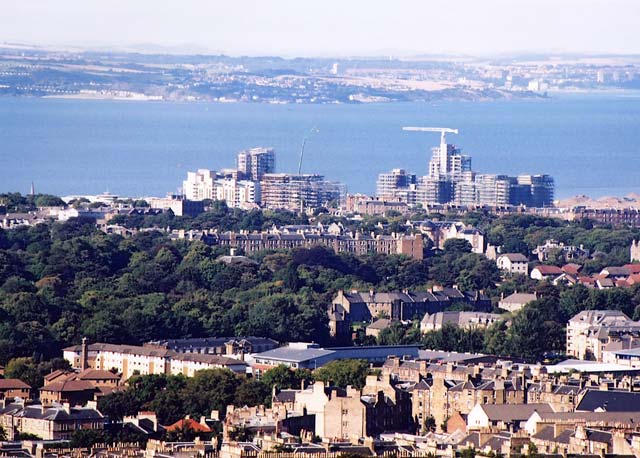
After the ceilidh had finished, I made my way in the direction of the city centre but there were still a couple of hours to kill before my train would leave. After a brief look round an art shop and a conversation with a couple of other people from the Manchester Folk & Ceilidh Society who I happened to meet coming out of the shop, I once again went to Greyfriars. Unfortunately, it was once again locked, so I made my way over to Holyrood Park for a walk. The hills in the park offered some impressive views of the city and of the North Sea, which made me even more annoyed at my failure to charge my phone before coming. Here are couple of photos I found on Google:

Finally, I made my way to Waverley station and got onto the train, eventually getting back to my house in Manchester at about 10 PM, covered in mud from a couple of falls in Holyrood Park (I considered dipping into the Scottish Parliament building with the intention of cleaning up, but reasoned that they weren't worthy of my dirt) but having thoroughly enjoyed the weekend. I'm now very much looking forward to the next IVFDFs, in Exeter (2015) and Warwick (2016)!
Thursday, 13 March 2014
What would a future of drone warfare entail?
Noah Smith recently wrote an article predicting that drone warfare is going to make sweeping, and likely disastrous, changes to our lives. It's an interesting article, well argued, and I would encourage you to read through it, but in case this is a brief reconstruction of the argument:
- For the last 700 years or so, warfare has been dominated by people with guns.
- Guns were in a sense a "democratising" force in warfare - needing little training to use, they have made it possible for the average person to take part in a conflict if necessary.
- While guns were not significantly more effective weapons than those preceding them, they were more efficient in terms of benefits (military effectiveness) versus costs (risk of death, need for training, costs of production*). Indeed, while planes and tanks are more dangerous than men with guns, they are less cost-effective and therefore men with guns are still the backbone of any military effort.
- However, drones are - or will soon be - more cost-effective than guns. Therefore, drones will replace people with guns as the key implement of warfare.
Up until this point, I would suggest that the argument does seem to be basically correct - and indeed fairly astute in terms of its analysis.
- This means that the people who control drones will have near-absolute power over those who don't.
- The massive inequality within our society will mean that rich people will have far greater access to drones than poor people.
- Hence, there will be no realistic way for poor people to threaten rich people. Rich people will no longer be constrained by the threat of violence, and with resources produced increasingly by automated processes they will not be dependent upon the poor for their prosperity either.
- Rich people will be able to take over nearly all resources and live lives of luxury, while the rest of humanity will be living on the scrapheap at near-starvation.
...
Okay, this is a pretty scary picture of the future. I'm particularly interested in the idea that ultimately it is inequality which will allow this to happen - as someone who does not see equality as valuable (though I have significant sympathies for Sufficientarianism), this seems like a good solid argument as to why inequality might genuinely be a severe problem. But let's break it down a little.
People who control drones will have near-absolute power over those who don't
I'm not certain it will be possible to fight entirely using drones. There will presumably still be a role for hacking, for bombs, and for infiltration (in the role of an engineer, an entertainer, an escort, etc). That said, let's accept this premise.
Inequality will mean that rich people will have far greater access to drones than poor people
This seems quite obviously true. However, this doesn't necessarily mean that they will have far greater military power. Remember that every single person has a single point of failure: that is, their body. Drones are likely to be available (at least in terms of cost) to pretty much everyone in the developed world, so I would see the principle as less one of overwhelming force than one of Mutually Assured Destruction: sure, some plutocrat can annihilate me and my family, but someone will be able to blow him up in return. I don't see this as necessarily a pleasant situation - it's not exactly clear how one would enforce any kind of justice in this situation, let alone "social" justice - but I doubt that any one person could simply take over the world.
Rich people can and will then take over all of the world's resources through force
Even if they had the ability to do this, this makes several assumptions which are disputable to say the least:
Even if they had the ability to do this, this makes several assumptions which are disputable to say the least:
- That they would want to. Most people are neither completely immoral or completely moral.
- That it would be in their interest. If they already have more than enough to not be reliant on poorer people for their services, why should they care about getting even more resources?
- That rich people have a coherent and unified class interest. "Rich people" is not the name of a single, very powerful organisation: it is a set - not even a group - of quite literally millions of people. Even if an individual rich person can clear all the poor people out of some area of value, what is the point of this if some other plutocrat will come along and take it off them? Perhaps there is some way that the first rich person could make his holdings secure, but then why couldn't this be practised by the original holders of the property?
So, while I'm not going to say that drone warfare is a positive development I don't think that it is anywhere near as terrible as Noah Smith believes.
* And, for the morally-inclined among you, risk of collateral damage to third parties.
PS. Another piece about drone warfare which ought to be more widely circulated.
Wednesday, 12 March 2014
Positive Rights for Animals?
In response to Mary Wollstonecraft's A Vindication of the Rights of Women, her former landlord and accomplished translator Thomas Taylor wrote a satirical book entitled A Vindication of the Rights of Brutes, which took the arguments Wollstonecraft had made in favour of women's rights and applied them to animals. Clearly in this context, The Rights of Brutes was intended as a reductio ad absurdum: back in the late eighteenth century, no-one in Britain would have taken seriously the proposition that animals had rights comparable to those of humans.
However, given many ideas which are nowadays commonly accepted I suspect that we are grossly hypocritical in our unwillingness to provide for the apparent positive rights of animals. My argument is roughly along these lines:
However, given many ideas which are nowadays commonly accepted I suspect that we are grossly hypocritical in our unwillingness to provide for the apparent positive rights of animals. My argument is roughly along these lines:
- Humans possess positive rights.
- There is some property which humans possess, by virtue of which they acquire these positive rights
- Animals also have this property, if not to the same extent as humans
- Therefore animals possess positive rights, if not as extensive as those of humans
I shall simply assume (1): personally I an not convinced that I agree with it, but it seems to be fairly widely accepted nowadays that there is a "right" to education and a "right" to healthcare.
(2) seems surely true if we accept (1): the idea that humans just *have* rights, and that there is no good reason for it, is strange if not contradictory. The question which we need to answer is, what is this property? I shall consider a number of examples and from this demonstrate the truth of (3), from which it seems that (4) follows logically.
Why might humans possess positive rights?
By saying that a person X has positive rights, I mean that others around them have an enforcible duty to provide certain goods and services to X if X does not or cannot provide them-self with such goods and service. If X has a right to healthcare, this means that should X fall ill and need healthcare then the people around them are morally obliged to pay for it.
Perhaps the most popular justification for such rights among modern political philosophers is simple membership of a society. The assumption tends to be that all members of a society implicitly contribute to all value created by that society, and therefore have a rights to some share of that value created. Can animals be considered part of a society? If by "society" we mean a group of persons/organisms providing each other with value, then yes: animals provide value as pets, as food, as entertainment. But when political philosophers talk of a society they more often mean something like "a group of people, all bound to a common set of rules". If animals follows these rules too, then this seemingly allows them, so perhaps our political philosopher might also impose some condition of consenting to these rules too. Requiring any kind of actual consent would go too far, since that doesn't exist even for humans, so we'll have to rely on hypothetical consent: "If humans were presented with these rules, they would agree to follow them." Even that is too strong - many of us wouldn't - so there will have to be something about a veil of ignorance to prevent us from consenting or not consenting on an individual basis. But if we're going this far away from real humans for their consent, then it doesn't seem unreasonable to suggest that animals should be considered in such a situation, as though they too were "as reasonable as rational beings" asked to consent to a set of rules.
In any case, this particular justification of positive rights is (in my opinion) complete hogwash. If people have positive rights, it is surely because there is something about humans which has intrinsic value. Claims about societies incurring duties for their members is silly as a political claim on numerous grounds (lack of voluntaryness, economic interaction has massive cross-society impact, etc) and moreover it suggests that we have no duties to those with whom we do not generally interact, such as isolated peasant communities, despite the fact that these are usually the people most in need of help! If someone is part of a community then they have an opportunity to improve their situation through trade and commerce: if we have a duty to help anyone it is the person without a society, isolated and compelled to be self-reliant.
Perhaps positive rights might be justified on grounds of agency? People make choices which can help or hinder others, and perhaps this somehow requires a certain standard of living in order to be properly informed about the choices they make. (I'm not bothering to put the argument in its strongest form, on the grounds that I see no need to knock it down). But if we accept a Compatibilist view of free will - the majority view among philosophers - then surely animals possess some kind of agency too? When confronted with a small child, a dog has the option of barking, of biting, or of lying on its back and waiting to be tickled. Obviously animals don't have as detailed a grasp of action than humans - a dog is unlikely to have much in the way of a system of ethics beyond "If I pee inside/ bark loudly at night/ run off when we're not at the park, then my master will shout at me," - but they are still capable of making these choices, which suggests that if we see agency as the source of the value of humans, animals also have this value.
Perhaps the ground of human value is more subjective - it is simply that we value humans, therefore they have value. In that case, animals - or at least some animals - obviously have value, because we value them enough to keep them as pets. And animals can value other animals - not just their children, but also animals in symbiotic or mutualistic relationships - so there's another source of value.
There are probably numerous other accounts of why humans are valuable, and I have neither the time nor the inclination to trawl through all of them. To finish, I'm simply going to point out that the idea that animals have positive rights is probably not as ridiculous as it sounds. Animal needs are presumably less diverse and easier to satisfy than those of humans - food, some kind of shelter, the option of socialising with other animals. And perhaps an iPad...
Sunday, 9 March 2014
IVFDF 2014 Recap, part 1
Last year, an event called IVFDF was mentioned in one of the Ceilidhs I went to as a weekend devoted to folk dancing. I decided to go along, and had a brilliant time (despite some infuriating bureaucracy relating to train tickets) so I was determined to return this year. The event circulates around the country, and this year it was held in Edinburgh. Again I had problems with my train tickets, although this time I can't really blame anyone else - in order to get there with some time to spare on the Friday, I had intended to miss an economics lecture which turned out to be a test worth 30% of our mark for the module, and missing it would entail giving up about 1.7% of my degree. Instead I rebooked my ticket and headed across on a later train, arriving after the dancing started but not to late to dance for most of the evening.


The first Ceilidh had music by Norman Mackay's Ceilidh Experience, and was set in South Hall at Pollock Halls. It's hard to imagine a better venue for a Ceilidh - a large, elegant, moderately lit hall with a side stage for the band, tables around the outside and a flight of stairs at one end from which I was able to take a few photos from above of the dances in progress. Unfortunately, I accidentally deleted all of the photos on my phone and can't find any online, so you'll just have to imagine it. The dancing was great fun, and there were some excellent beard/kilt combinations on display.
At about 10:30 PM I headed across to the South Side Community Centre, where at the Hobgoblin Stage the Climax Ceilidh Band were performing. The place was a town hall of the sort I assume they stopped building in the 50s, replete with outmoded decor. There was a large seated area behind the band and there were chairs around the outside of the dancing area. The band seemed fairly good - in particular, I remember a jig version of Gotye's Somebody That I Used To Know. I headed off to get to bed before the end of the Cielidh in order to avoid wearing my legs out at the beginning of the weekend, and in order to plan for the next day without needing to keep people up with the light.

A dance in progress at the Hobgoblin Stage, taken from where the band would have been. Note the wheelchair, it'll come up again later.
The traditional way to stay at IVFDF is indoor camping - last year I spent two nights on a church floor, this year in a sports hall. There were showers, which was a significant improvement upon last year.
The next morning, I headed off to Teviot Hall for a session dedicated to playing folk music from the Auvergne, taught by Duo Mistral. The session was enjoyable - I don't remember much of the music now, and I've asked them to email me a copy of the recording of the session which they took but it has yet to come. After this I walked to Pleasance for a Latin-American dance workshop. I only attended the first half of this, bowing out in order to buy the largest water bottle I could get, but in that time we did an Incan or possibly pre-Incan dance for couples, a religious rite whose purpose I forget. It was very improvisational, the only constant being that the dancers were circling around.
Following this, there was a session on wheelchair dancing - how to dance in a wheelchair, and how to dance partnered with someone in a wheelchair. This had numerous amusing moments, beginning with an attempt to Thread the Needle, leading to an attempt to Duck and Dive (couples stand in a queue, lead couple facing all the others; all couples join hands, and the lead couple walk down the line alternating between arching over the approaching couple and ducking under an arch formed by the approaching couple - in wheelchairs, this manifested itself as a two-way slalom) and culminating in a Suicide Square, in which the tops and bottoms of the square gallop into the middle before retreating, and have to be certain to be out in time for the oncoming side couples.
After grabbing lunch, I headed into town in order to observe something of the Morris-Dancing tour of the city and to visit the city centre myself. Morris Dancing is something which I thought was silly until I actually saw it live for the first time, at IVFDF 2013 in Sheffield, and now it is something I really want to try. After watching the dances which happened outside the Scottish National Gallery, and taking a few photos of the dancing, the inner-city gardens and the Scott Monument, I had a look round the Scottish National Gallery, which had more worthwhile paintings than I have the time to find pictures of. Here are just a couple of the paintings I enjoyed:

Sir Henry Raeburn

Arthur Melville

William McTaggart
After this I had intended to go to Greyfriars Kirkyard in order to visit the grave of one of the great Scottish poets, inspired by a friend of a friend who had also recently visited. Unfortunately, the gate was locked, so I had to just give up and head over to Teviot where there was a concert being given by various local singer-songwriters, plus a group of pseudo-Georgian bellowers.
The first performer was The Muldrew, performing three songs from his new LP. I thought his production held him back - that is to say, his use of live-recorded sounds prevented him from doing much of interest with the music - it would just be the same two or four chords played repeatedly for several minutes, with the mix changing a bit over time. It also sometimes added up to rather unpleasant sound. That said, he demonstrated proficiency on the guitar (if not on the keyboard, which was nothing but bass chords). In the end, I didn't enjoy it and didn't feel enriched by it.
Next up were The Eilidhs. Consisting of harpist and singer Eilidh Munro and fiddler Eilidh Steel, they were my favourite act of the concert. They performed a variety of traditional songs, and also had an LP coming out soon although it has yet to appear. Munro performed the finest singing I can remember hearing. Needless to say, when the LP does come out I will be getting hold of it.
"You know Bacon Numbers? Well, I have a folk music number of two." With those words, Charlotte Repton introduced her brand of baritone-ukulele light-comedy (?). I don't have a particular desire to listen to her again, but it was a perfectly reasonable way to spend half an hour of a Saturday afternoon. If you want to listen to her, I'd recommend starting with either Clockwork Heart or Alley Creepin'.
Finally, the pseudo-Georgian bellowers. Actually a group of Edinburgh men who happened to enjoy Georgian mountain songs, it fit pretty much exactly the description of Ogre music from Warhammer Fantasy. I didn't enjoy it, but I do feel enriched for having heard it. And at least it's killed my interest in composing a piece entirely of shouting, which had been mulling around in my head for quite some time. The group can be found here, and here is an excerpt from a piece which they sang in this concert.
Following on from this, I had a terrible meal in the Green Mantle pub - if you are vegetarian, avoid that place because all they have is some rather unpleasant soya. The complete absence of salad did little to help the already dubious culinary reputation of Scotland. After this, I headed off to the evening dancing.
To be continued... hopefully.
Holiday in Somalia
One popular criticism of anarchism is to point to the violent civil war going on in Somalia, and say that this is what happens when you have anarchy. Anarchists are of course used to this, and clearly we disagree or else we wouldn't - at least in general - be anarchists. I can imagine that there are some who take an extreme "government should not violate rights, regardless of the consequences, and if that leads to a Hobbesian nightmare then at least we are morally beyond reproach" line, but am personally confident that somewhere along the line I would be happy to give up rights if that were necessary to preserve a civilised society. There's a discussion of Somalia currently going on in the Anarcho-Capitalism subreddit, which led me to do a bit of reading up on the subject. This is my attempt to present the various arguments used.
(1) The war was caused by the state, in a particularly bad consequence of the fall of communism. Observe that all of the warlords, at first, were generals in the Somalian army before.
(2) Warlords are government - they violate the non-aggression principle as surely as any state.
(3) Somalia isn't really anarchy - it's a bunch of small states, all of whom happen to be at war with one another.
(4) Somalia really isn't as bad as we think - compared to other African countries, it is actually doing pretty well.
(5) Within any political system there will be nations which do better or worse within that system. Somalia is likely a particularly bad example of anarchism, and comparing it to developed countries (as tend to be done is grossly unfair). The best comparison would be somewhere like North Korea, and for all its violence most people would rather live in Somalia than North Korea.
(6) A functioning anarchy requires people to understand and accept anarchism - it cannot simply develop out of thin air. (I'm not presenting this well here, see here for a short but well-written exposition of the argument).
Without commenting on the force or truth of any of these arguments (hint: I agree with some but not all - in particular, (2) just seems like an attempt to redefine the word 'government' to include anything we don't like) it seems to me like there is a split between these arguments: arguments (1), (2), (3) and (6) all seem to say "Somalia isn't truly anarchist" whereas (4) and (5) say "Yes, Somalia is anarchist, and it really isn't so bad." There isn't necessarily a contradiction - you could probably argue that anarchy developed out of a failed state - but in general it seems like these are two different conclusions being argued towards, and the combination of the two - "The violence in Somalia is because they have a government, and because they're anarchist they're actually doing better than other countries in their situation" - is flat out contradictory.
Subscribe to:
Posts (Atom)